
71%
of lines contain at least one model mistake (114 and 111 of 161 lines)
Method case study · Human-verified eval · Historical Urdu Nastaliq
We ran a blind test of Claude Opus 5.5 and Claude Fable 5.1 on a 1908 lithographed Urdu dictionary, scored word by word against ground truth typed by a native expert. Every disagreement was ruled against the scan. The sample, the method and the word-level results are published here. This is one example of our method: the same blind, expert-written, adjudicated harness applies in any domain where a vetted expert can write the truth, from clinical medicine and law to physics and engineering.
71%
of lines contain at least one model mistake (114 and 111 of 161 lines)
55 · 50
words each model got wrong with no doubt flagged (Opus · Fable)
90 · 91%
strict word accuracy (Opus 89.95% · Fable 91.08%): about 1 word in 10 not reproduced exactly
130 · 113
diacritics written by the katib that each model dropped
What the test shows
Both models were told to flag any word they were unsure of. They still misread 55 and 50 words without a flag. Nothing in the output marks them as wrong.
The katib wrote pre-Partition Urdu in full rasm-ul-khat, with shadd, jazm, zer and pesh. The models dropped 130 and 113 of these marks, rewriting 1908 as modern print.
Urdu has 246 million speakers (Ethnologue 2025), yet it appears in none of the 52 disclosed AI data-licensing deals compiled by Neudata. Verified ground truth for historical Nastaliq is scarce, so there is little to train on and nothing standard to measure against.
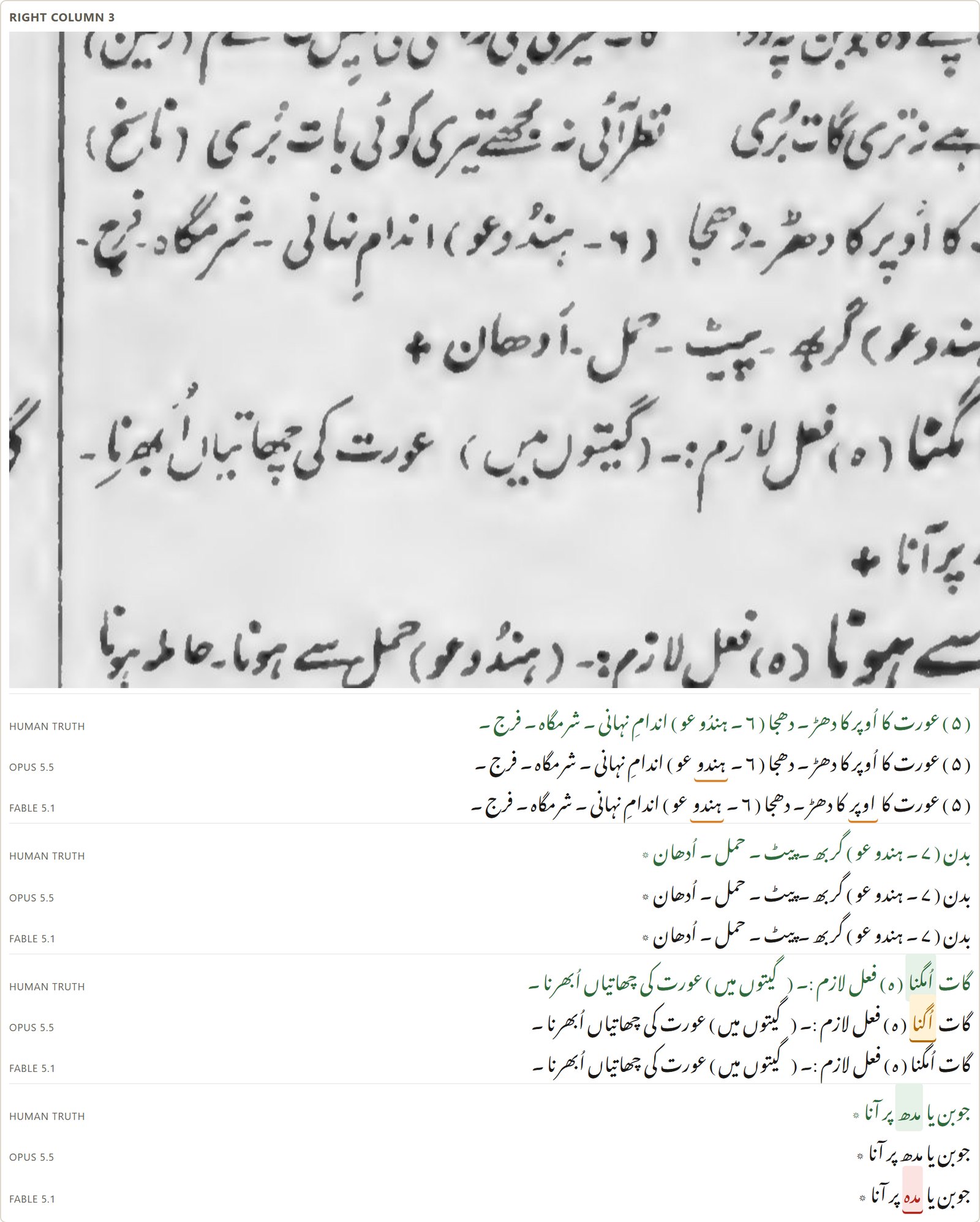
Results
Strict word accuracy is the share of the human truth's words reproduced exactly: a word is wrong if it is misread, missing, loses or changes a diacritic, or differs in punctuation, spacing or order. Reading accuracy is a lenient secondary view that counts only misread, missing and invented words. Silent errors are reading errors with no doubt flag.
| Page | Opus 5.5 strict word accuracy | Reading accuracy | Misread | Silent | Fable 5.1 strict word accuracy | Reading accuracy | Misread | Silent |
|---|---|---|---|---|---|---|---|---|
| Page 12 | 93.10% | 98.71% | 6 | 4 | 94.83% | 97.20% | 13 | 6 |
| Page 13 | 88.44% | 96.15% | 37 | 22 | 89.58% | 95.00% | 48 | 26 |
| Page 14 | 89.94% | 95.70% | 41 | 29 | 90.78% | 96.12% | 37 | 18 |
| All 3 pages | 89.95% | 96.47% | 84 | 55 | 91.08% | 95.88% | 98 | 50 |
Human truth: 2,378 words and marks over 161 lines, typed blind in 166 minutes.
The eval harness
Provenance
Source
Farhang-i-Asifiyah, vol. 4 (1908), compiled by Syed Ahmad Dehlvi (1846–1918). Public domain in the US and in its countries of origin. Pages 12–14.
Human-only truth
The ground truth is typed by people from the scan. Model outputs appear only as scored evaluation evidence.
Behind the sample
124 titles sourced (49,421 pages) in Urdu, Punjabi, Sindhi, Pashto, Balochi and Saraiki, selected as public-domain works published before 1931.
Data format
A real record
{
  "page": 13,
  "model": "claude-fable-5-1",
  "band": "R3",
  "truth": "مدھ",
  "model_output": "مدہ",
  "result": "wrong_word",
  "model_flagged_doubt": false,
  "reading_error": true,
  "scan_crop": "p13_R3.png"
}
Work with us
Pilot: a 250-page held-out set of historical Nastaliq, scored against your model with this harness. We send the scans, you send your model's output, and we return the scorecard and full error log. Your model never sees the truth.
Request a pilot
Working on it…
This usually takes a few seconds.
Popular: Email code · Application statuses · Payments